MND & Neuromuscular Conditions and physiotherapy
Living with a condition that causes muscle weakness can change the way you move, exercise and manage everyday tasks. Physiotherapy can help you maintain movement, manage changes in function and find ways to stay as active and independent as possible.
The Rehab Team provides neurological physiotherapy for people living with motor neurone disease (MND), muscular dystrophy and other neuromuscular conditions.
Our approach is individualised to your diagnosis, current abilities and goals. Rehabilitation isn't about pushing through weakness or exercising as hard as possible. Instead, we consider what your body can manage and how physiotherapy can best support your function and quality of life.
What are neuromuscular conditions?
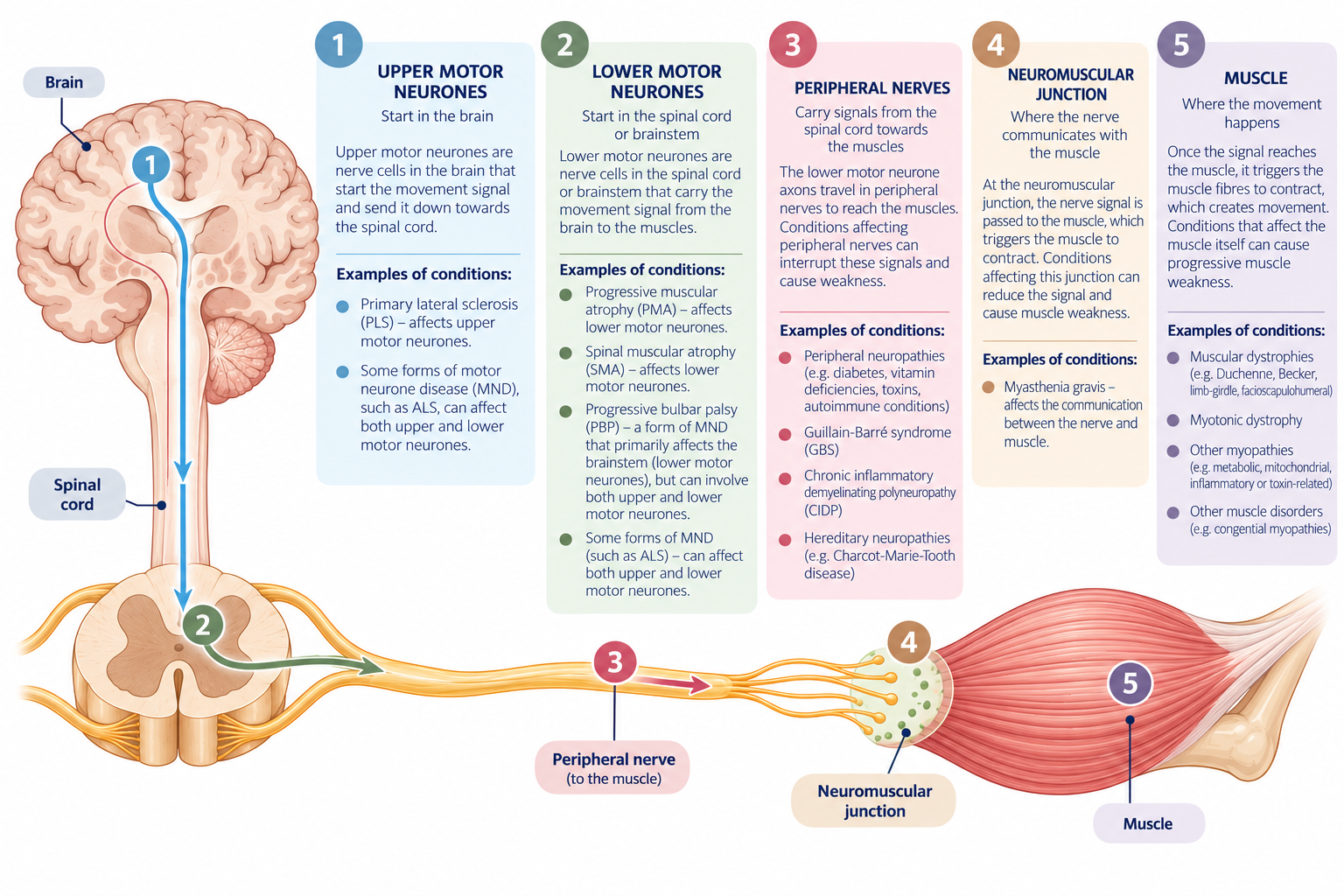
Neuromuscular conditions affect the muscles and/or the nerves that control them. There are many different types, and they can affect people in very different ways. Some conditions affect the motor nerves responsible for controlling movement, while others primarily affect the muscles themselves. Some are inherited, while others develop during a person's lifetime.
Examples include motor neurone disease, muscular dystrophies, spinal muscular atrophy, myotonic dystrophy and other inherited or acquired neuromuscular conditions.
Motor neurone disease (MND)
Motor neurone disease affects the nerve cells responsible for controlling voluntary muscle movement. As these motor neurones become damaged, muscles can gradually become weaker. MND can affect different parts of the body and progress in different ways. Some people initially notice changes in their walking or leg strength, while others may first experience weakness in their hands and arms, or changes in speech and swallowing.
MND includes different clinical patterns and related conditions, including:
Amyotrophic lateral sclerosis (ALS) – affects both upper and lower motor neurones and is the most common form of MND in many countries.
Progressive muscular atrophy (PMA) – primarily affects lower motor neurones and can cause progressive muscle weakness and wasting.
Primary lateral sclerosis (PLS) – primarily affects upper motor neurones, resulting in stiffness, weakness and changes in movement.
Progressive bulbar palsy (PBP) – predominantly affects the muscles involved in speech and swallowing.
Muscular dystrophy and other neuromuscular conditions
Muscular dystrophies are a group of inherited conditions that cause progressive muscle weakness. Different types affect different muscle groups and can have very different patterns of onset and progression.
Examples include:
Duchenne muscular dystrophy (DMD) – typically begins in childhood and causes progressive muscle weakness.
Becker muscular dystrophy – similar to Duchenne muscular dystrophy but generally has a later onset and slower progression.
Limb-girdle muscular dystrophies – a group of conditions that primarily affect the muscles around the hips and shoulders.
Facioscapulohumeral muscular dystrophy (FSHD) – commonly affects the muscles of the face, shoulder blades and upper arms.
Myotonic dystrophy – can cause muscle weakness and myotonia, where muscles have difficulty relaxing after contraction.
Other neuromuscular conditions include spinal muscular atrophy (SMA) and a wide range of inherited and acquired myopathies.
How can physiotherapy help?
The role of physiotherapy will depend on your diagnosis, symptoms, stage of the condition and individual goals.
Physiotherapy can help maintain joint movement and flexibility, support mobility and transfers, manage stiffness, address balance and falls risk, and help you remain physically active where appropriate. It can also provide strategies for managing fatigue and adapting everyday activities as your abilities change.
Exercise needs to be carefully considered in neuromuscular conditions. More exercise is not necessarily better, and some people may be vulnerable to excessive fatigue or muscle overwork. Your physiotherapist can help determine what type and amount of activity is appropriate for you.
Sometimes maintaining independence means making an activity easier rather than trying to become stronger. Walking aids, wheelchairs or other equipment may help you continue doing the things that are important to you.
Physiotherapy can also work alongside occupational therapy and other members of your healthcare team when additional support or equipment is needed.
Rehabilitation can change over time
Neuromuscular conditions change over time, so your rehabilitation needs are likely to change too.
At one stage, physiotherapy may focus on maintaining mobility and physical activity. Later, the focus may shift towards managing fatigue, maintaining flexibility, adapting activities or finding ways to make everyday tasks easier.
The goals simply change as your needs change. The aim is to help you do as much as possible, as safely and comfortably as possible, while supporting the things that are important to you.
How The Rehab Team can help
Neurological rehabilitation is what we do every day.
The Rehab Team provides individualised neurological physiotherapy for people living with MND, muscular dystrophy and other neuromuscular conditions.
We provide in-home neurological physiotherapy throughout Tauranga.
If you or someone you care for is living with a neuromuscular condition and would like to discuss how physiotherapy could help, get in touch with The Rehab Team.
Want to know more?
Have a look at The Rehab Team's other blogs here