Understanding Ataxia: causes, symptoms & physiotherapy
Ataxia can make everyday movement feel less steady, less accurate and harder to control. Understanding what is causing the ataxia is an important first step in knowing how it can be managed.
Ataxia can affect walking, balance, coordination and the ability to control precise movements. Physiotherapy can play an important role in helping people with ataxia maintain movement, manage balance and mobility difficulties, reduce falls risk and remain as independent and active as possible.
What is ataxia?
Ataxia occurs when there is damage or dysfunction within the nervous system, particularly the cerebellum or the pathways connecting it with other areas of the brain and spinal cord.
Ataxia is a symptom or clinical sign rather than a single disease. The cerebellum plays an important role in coordinating movement, balance, posture and the timing and accuracy of movements. When these systems are affected, movements can become less coordinated or less predictable.
What causes ataxia?
Ataxia is commonly grouped into three broad categories:
Acquired ataxia
Acquired ataxia develops during a person's lifetime as a result of another condition, injury, exposure or medical problem. Possible causes include:
Stroke: A stroke affecting the cerebellum or other areas involved in coordination can cause sudden problems with balance, walking and movement control.
Head injury: Traumatic brain injury can damage the cerebellum or other pathways involved in coordination and balance.
Multiple Sclerosis: Changes within the brain and spinal cord can disrupt the pathways responsible for coordinating movement.
Infections: Some infections, including certain viral or bacterial infections, can affect the nervous system and result in ataxia.
Tumours and other structural conditions: A tumour or other structural problem affecting the cerebellum or its surrounding pathways can interfere with coordination and balance.
Some acquired causes of ataxia can be treated or improved when the underlying cause is identified.
Inherited ataxias
Inherited ataxias are caused by genetic changes that affect how nerve cells function or survive. There are many different inherited ataxias, and they can be inherited in different ways. Examples include:
Friedreich's ataxia: Usually caused by changes in the FXN gene, which affects production of a protein called frataxin. It can cause progressive problems with coordination, balance, strength and sensation, and may also affect other body systems.
Ataxia-telangiectasia: A rare inherited condition caused by changes in the ATM gene. It can affect coordination and balance as well as the immune system and other body systems.
Spinocerebellar ataxias (SCAs): A group of genetically different inherited conditions affecting the cerebellum and its connections. Many are inherited in an autosomal dominant pattern and can cause progressive difficulties with coordination, balance, speech and movement.
Idiopathic ataxia
Sometimes, despite appropriate investigation, an underlying cause cannot be identified. This may be described as idiopathic ataxia, meaning that the cause is unknown.
What are the symptoms of ataxia?
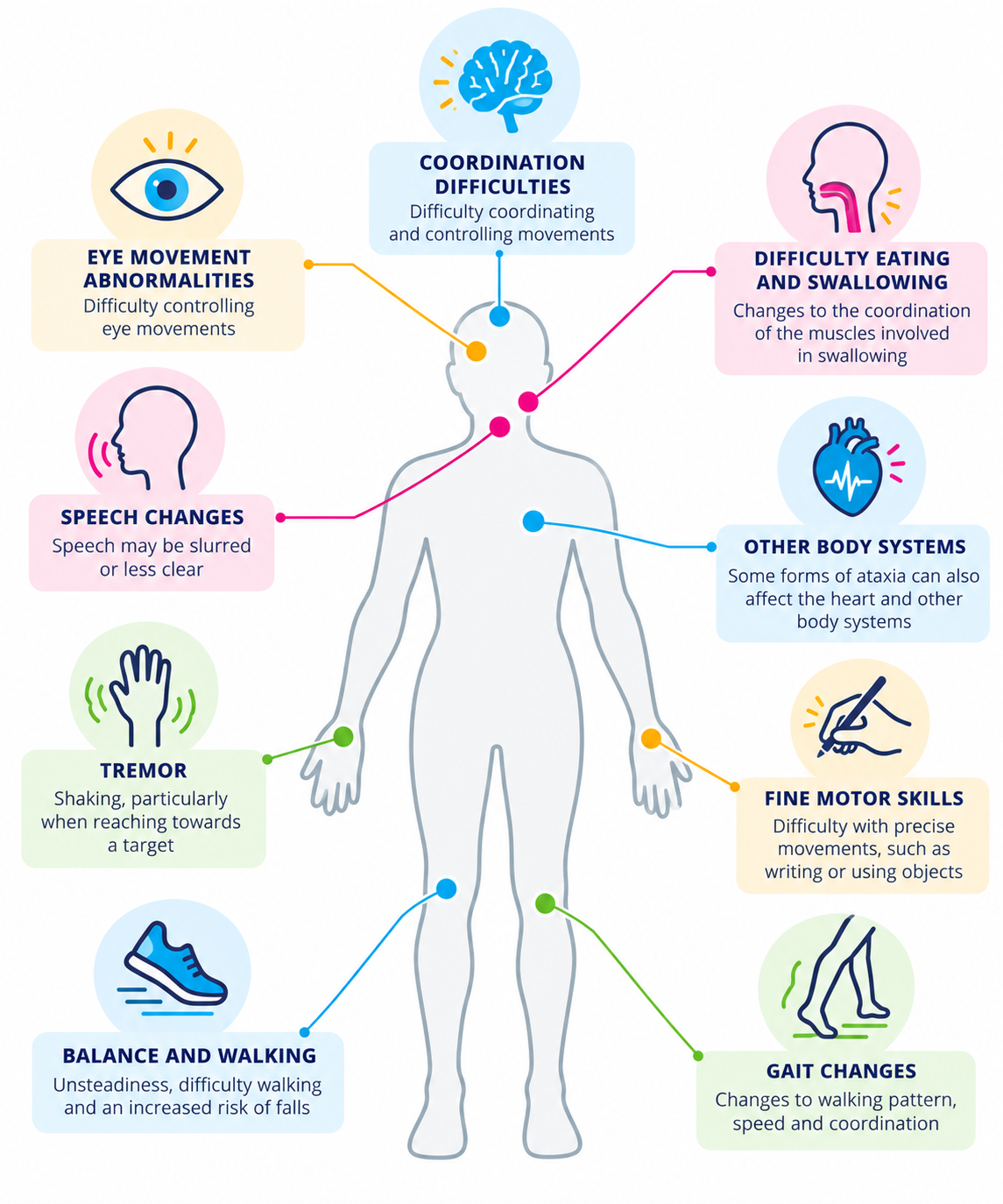
Ataxia can affect movement in different ways, and not everyone will experience the same symptoms.
Balance and walking: Walking may become wider-based, slower or less predictable. Turning, walking on uneven surfaces or moving through busy environments can become more challenging.
Coordination: Movements of the arms and hands may become less accurate, jerky or more difficult to control. Under or overshooting a target can be common. Everyday activities such as writing, eating, dressing or using tools may take more time or concentration.
Tremor and involuntary movements: Some people with ataxia experience intention tremor, where shaking becomes more noticeable as the hand approaches a target.
Speech and swallowing: Ataxia can affect the coordination of the muscles involved in speaking and swallowing. Speech and language therapy may be appropriate when these symptoms are present.
How can physiotherapy help with ataxia?
Physiotherapy is an important part of rehabilitation for many people with ataxia.
For people with progressive or inherited ataxias, early rehabilitation can help establish strategies to maintain function and manage changes in balance, coordination and mobility. Ataxia UK recommends a combination of restorative and compensatory approaches, tailored to each persons presentation and their goals.
Balance and falls prevention: Balance exercises and practical strategies can help improve stability, confidence and safety during everyday activities. Falls can be a significant concern for people with ataxia, so assessing your individual falls risk and developing strategies to reduce this risk is an important part of rehabilitation.
Walking and mobility: Physiotherapy can help you work on walking, turning, negotiating different environments and safely managing community mobility. Where appropriate, we can also assess whether a walking aid or other mobility equipment could improve your safety and independence.
Coordination and movement control: Rehabilitation may include repeated practice of meaningful movements and activities to help you develop strategies for improving movement accuracy and control.
Strength and physical function: Maintaining strength and physical capacity can be important for people with ataxia. Exercise should be individually prescribed according to your abilities, symptoms, health and safety considerations. The aim is not to follow a generic exercise programme, but to find an approach that is appropriate and sustainable for you.
Equipment and independence: As mobility changes, the right equipment or adaptations may help you remain active and independent. Physiotherapists can provide advice around mobility aids, while occupational therapists can assist with equipment and adaptations for everyday activities.
Can physiotherapy improve ataxia?
This is an important question, particularly for people with inherited or progressive ataxias. Physiotherapy cannot cure an inherited genetic condition. However, physiotherapy can help some people improve aspects of gait, balance, coordination and daily function. It can also help people develop strategies to compensate for movement difficulties and maintain participation in everyday activities.
The goals of physiotherapy may therefore change over time. Sometimes the goal is to improve a particular movement or activity. At other times, it may be to maintain current abilities, reduce falls, preserve physical capacity or find safer ways to remain independent.
When might physiotherapy be helpful?
Physiotherapy can be useful at different stages of ataxia. You may benefit from an assessment if you are:
experiencing increasing unsteadiness or falls
finding walking or transfers more difficult
noticing changes in coordination
struggling with everyday activities because of movement difficulties
unsure whether your current exercise programme is appropriate
considering whether a walking aid could improve your safety
For progressive ataxias, rehabilitation does not need to wait until mobility has significantly declined. Early assessment can help establish strategies for maintaining function and independence.
How The Rehab Team can help
At The Rehab Team, neurological rehabilitation is what we do every day.
Our Neurological Physiotherapists provide individualised rehabilitation for people living with ataxia, including inherited and progressive ataxias.
We provide in-home neurological physiotherapy throughout Tauranga, Papamoa, Mount Maunganui and surrounding areas.
Contact The Rehab Team to discuss whether neurological physiotherapy may be appropriate for you.
Want to know more?
Have a look at The Rehab Team's other blogs here