Dizziness, Vertigo & Balance Physiotherapy
Vestibular Rehabilitation in Tauranga, Papamoa & Mount Maunganui
Does dizziness or unsteadiness make you feel less confident doing the things you normally enjoy?
Dizziness can be difficult to describe and may feel like spinning, light-headedness, motion sensitivity, feeling off balance or simply not feeling steady on your feet. For some people, symptoms are brief and occasional. For others, dizziness or balance problems can become persistent and start to affect walking, exercise, work, driving or everyday activities.
The Rehab Team provides neurological and vestibular physiotherapy for people experiencing dizziness, vertigo and balance difficulties. Our assessment looks at the different systems that contribute to balance so we can understand what may be driving your symptoms and develop an appropriate rehabilitation plan.

Neurological and vestibular rehabilitation is what we do every day. Our clinicians work with both vestibular conditions and neurological conditions that can affect balance, movement and spatial awareness.
We provide in-home vestibular physiotherapy throughout Tauranga, Papamoa and Mount Maunganui.
What can cause dizziness, vertigo and balance problems?
There are many different causes of dizziness and imbalance. Some common conditions we assess and treat include:
Benign Paroxysmal Positional Vertigo (BPPV)
Vestibular migraine
Vestibular hypofunction
Vestibular neuritis and labyrinthitis
Ménière’s disease
Persistent Postural-Perceptual Dizziness (PPPD)
Visual motion sensitivity
Concussion and traumatic brain injury
Balance problems following stroke
Balance difficulties associated with Parkinson’s disease, Multiple Sclerosis and other neurological conditions
Age-related changes in balance and falls risk
Not all dizziness is caused by the vestibular system. Symptoms can have multiple contributing factors, which is why a detailed assessment is important.
How can vestibular physiotherapy help?
Your first appointment includes a detailed assessment of your symptoms, medical history and how your balance systems are functioning.
Depending on your presentation, this may include assessment of:
Vestibular function: Assessing how your inner-ear balance system is contributing to your symptoms.
Eye movements and visual-vestibular interaction: Looking at how your eyes and vestibular system work together to stabilise your vision when your head moves.
Balance and walking: Assessing balance, walking, movement strategies and factors that may increase your risk of falling.
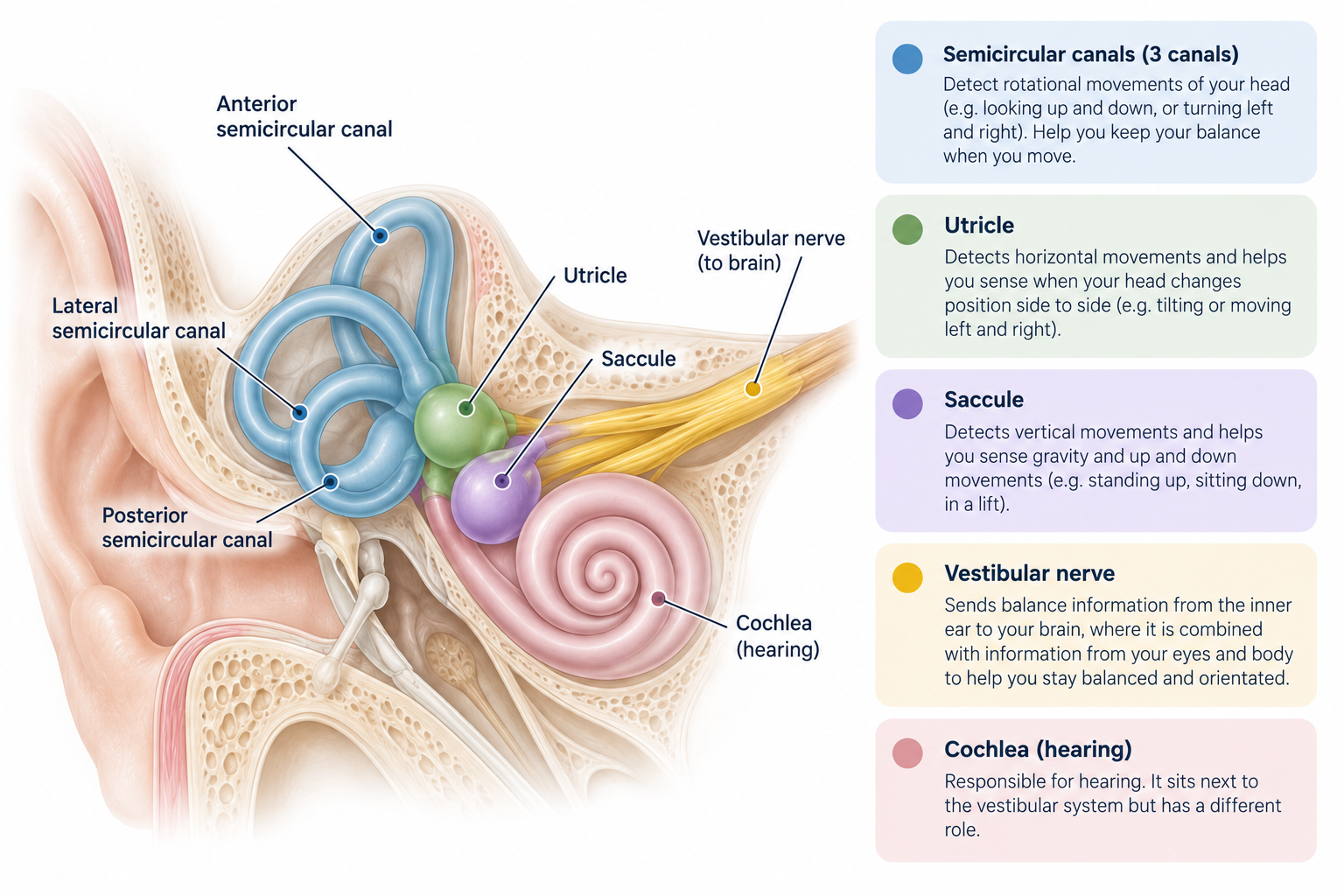
Positional testing: Where appropriate, specific tests can help identify BPPV and determine which semicircular canal is involved.
Neurological and functional factors: Considering how the brain, sensory systems, strength, coordination and other neurological factors may be contributing to your balance difficulties.
What does vestibular rehabilitation involve?
Vestibular rehabilitation is not one standard exercise programme. Treatment depends on the underlying problem and your goals. Your rehabilitation may include:
Repositioning manoeuvres: Specific manoeuvres can be used to treat BPPV by moving displaced crystals within the inner ear back into the appropriate position. BPPV is highly treatable when correctly identified.
Gaze stabilisation: Exercises designed to improve the ability to keep your vision stable while your head moves.
Habituation and graded exposure: Gradually introducing movements or environments that provoke symptoms to help improve tolerance and reduce avoidance.
Balance retraining: Challenging and improving the different sensory systems your brain uses to maintain balance.
Walking and functional rehabilitation: Working on movement, confidence and safety during everyday activities and community mobility.
Education and self-management: Helping you understand your symptoms and giving you strategies and exercises that you can continue independently.

Dizziness and neurological conditions
Balance problems are not always caused by an inner-ear disorder.
Neurological conditions such as stroke, Parkinson’s disease, Multiple Sclerosis, Functional Neurological Disorder and brain injury can affect balance, coordination, sensory processing and the brain's ability to integrate information from the eyes, inner ear and body.
In these situations, rehabilitation may focus on improving balance and movement while also addressing the underlying neurological condition.
For people experiencing persistent or unexplained dizziness, we can also help identify when further medical or specialist assessment may be appropriate.
Read more about dizziness and vertigo
We have written several articles to help you understand common causes of dizziness and what vestibular rehabilitation involves.
Why Am I Feeling Dizzy? An overview of common causes of dizziness and vertigo.
Vertigo When Rolling Over in Bed: A closer look at BPPV and why changing position can trigger spinning.
Persistent Postural-Perceptual Dizziness (PPPD): Understanding persistent dizziness, visual sensitivity and how rehabilitation can help.
How The Rehab Team can help
At The Rehab Team, neurological and vestibular rehabilitation is what we do every day.
Our Neurological Physiotherapists provide individualised vestibular and neurological rehabilitation for people experiencing dizziness, vertigo, balance problems and falls.
We provide in-home vestibular physiotherapy throughout Tauranga, Papamoa and Mount Maunganui, allowing us to assess how your symptoms affect you in your own environment.
Contact The Rehab Team today to arrange a vestibular physiotherapy assessment.