Functional Neurological Disorder.
FND Physiotherapy in Tauranga, Papamoa & Mount Maunganui
Have you been diagnosed with FND but still feel like you don't fully understand what is happening to your body?
FND symptoms are real and can be frustrating, unpredictable and difficult to explain. For many people, understanding what FND is — and knowing that there are evidence-informed rehabilitation approaches available — is an important first step.
FND can cause very real and often disabling neurological symptoms, including weakness, tremor, abnormal movements, sensory changes, walking difficulties, functional seizures, fatigue and cognitive symptoms. Symptoms can fluctuate significantly and may change from day to day.

The Rehab Team provides expert neurological physiotherapy for people living with FND, with rehabilitation focused on helping you understand your symptoms, regain control of movement and build confidence in your ability to function.
Neurological rehabilitation is what we do every day. Our clinicians work with people living with neurological conditions every day and understand that FND requires a different rehabilitation approach from a standard musculoskeletal injury.
We provide in-home FND physiotherapy throughout Tauranga, Papamoa and Mount Maunganui. Online appointments are also available throughout New Zealand and have worked particularly well for many people with FND, allowing us to support people who are unable to attend face-to-face appointments locally.
What is Functional Neurological Disorder?
Functional Neurological Disorder is a condition where the functioning of the nervous system is affected, resulting in genuine neurological symptoms.
FND is increasingly understood as involving changes in how different brain networks communicate and process information. Networks involved in movement, attention, emotion, sensory processing, interoception (how you sense and interpret what is happening inside your body) and sense of agency (your feeling that you are in control of your own movements) can interact differently in FND.
This does not mean that there is structural damage to the brain. Instead, the brain and body may be processing and responding to information differently. Importantly, FND symptoms are real, involuntary and not deliberately produced.
What causes FND?
There is no single cause of FND.
FND is thought to develop through an interaction of different factors that can vary considerably between individuals. These may include previous illness or injury, pain, changes in sensory processing, physical stress, fatigue, autonomic symptoms, attention, expectations and psychological or emotional factors.
Some people can identify a clear trigger, while others cannot. You do not need to have experienced trauma, anxiety or depression to develop FND.
Current models recognise FND as a complex interaction between the brain, body and environment rather than a condition with one simple cause.
How is FND diagnosed?
FND is not simply a diagnosis of exclusion.
A neurologist or other appropriately trained clinician can diagnose FND by identifying positive clinical signs that demonstrate characteristic changes in neurological function. Examples include Hoover’s sign for functional weakness and entrainment testing for functional tremor.
Brain scans and other investigations may still be required to assess for other neurological conditions. A normal MRI does not itself diagnose FND, and an abnormal scan does not automatically exclude FND.
If you have not yet received a diagnosis, we can discuss your symptoms and help you understand whether a medical or neurological assessment may be appropriate before commencing rehabilitation.
How can physiotherapy help with FND?
FND rehabilitation is different from simply strengthening a weak muscle or treating an injured joint. Our approach is based around retraining movement and function, with the aim of helping you regain a sense of control over your symptoms. Your rehabilitation may include:
Movement retraining: We work on automatic and functional movement rather than repeatedly focusing attention on the affected body part. External focus, rhythm, distraction and task-based strategies may help reduce excessive self-focused attention and encourage more automatic movement.
Motor learning: Motor learning is an important part of FND rehabilitation. We use repeated, meaningful practice to help you develop more efficient and automatic movement patterns. This may involve changing how you think about a movement, using different sensory or external cues, and gradually increasing the complexity of a task.
Sensory and motor retraining: Where appropriate, rehabilitation may address changes in sensation, body awareness, coordination and motor control.
Autonomic regulation: Some people with FND also experience symptoms of autonomic nervous system dysregulation, such as changes in heart rate, dizziness, fatigue, temperature regulation or exercise tolerance. Where relevant, rehabilitation may include strategies to improve autonomic regulation, activity tolerance, breathing and gradual physical conditioning.
Graded activity and exercise: Exercise is individually prescribed and progressed according to your symptoms, current capacity and goals. FND rehabilitation is not about simply pushing through symptoms or following a generic strengthening programme.
Understanding symptoms and triggers: We help you identify factors that may influence your symptoms, such as fatigue, pain, attention, stress, sensory overload or changes in routine. Understanding these patterns can help you develop practical strategies for managing fluctuations and flare-ups.
Self-management: A key goal of rehabilitation is helping you become confident managing your symptoms independently. This includes developing strategies for maintaining progress, responding to setbacks and gradually returning to meaningful activities.
For people with functional seizures, rehabilitation may include education, identification of individual triggers and development of a personalised management plan. Functional seizures require appropriate medical assessment and may benefit from psychological input alongside physical rehabilitation.
The brain, prediction and the nocebo effect
One area of growing interest in FND research is predictive processing — the idea that the brain constantly uses previous experiences and expectations to help interpret incoming information from the body and environment.
In some people with FND, expectations, attention and previous experiences may influence how symptoms are perceived and expressed. This overlaps with research into nocebo effects, where negative expectations can contribute to increased symptoms.
This does not mean that symptoms are imagined or consciously created. These processes can occur outside conscious awareness and are being investigated as part of the brain mechanisms involved in FND.
Predictive processing is an evolving area of FND research, rather than a single proven explanation for every person's symptoms.
What does functional MRI tell us about FND?
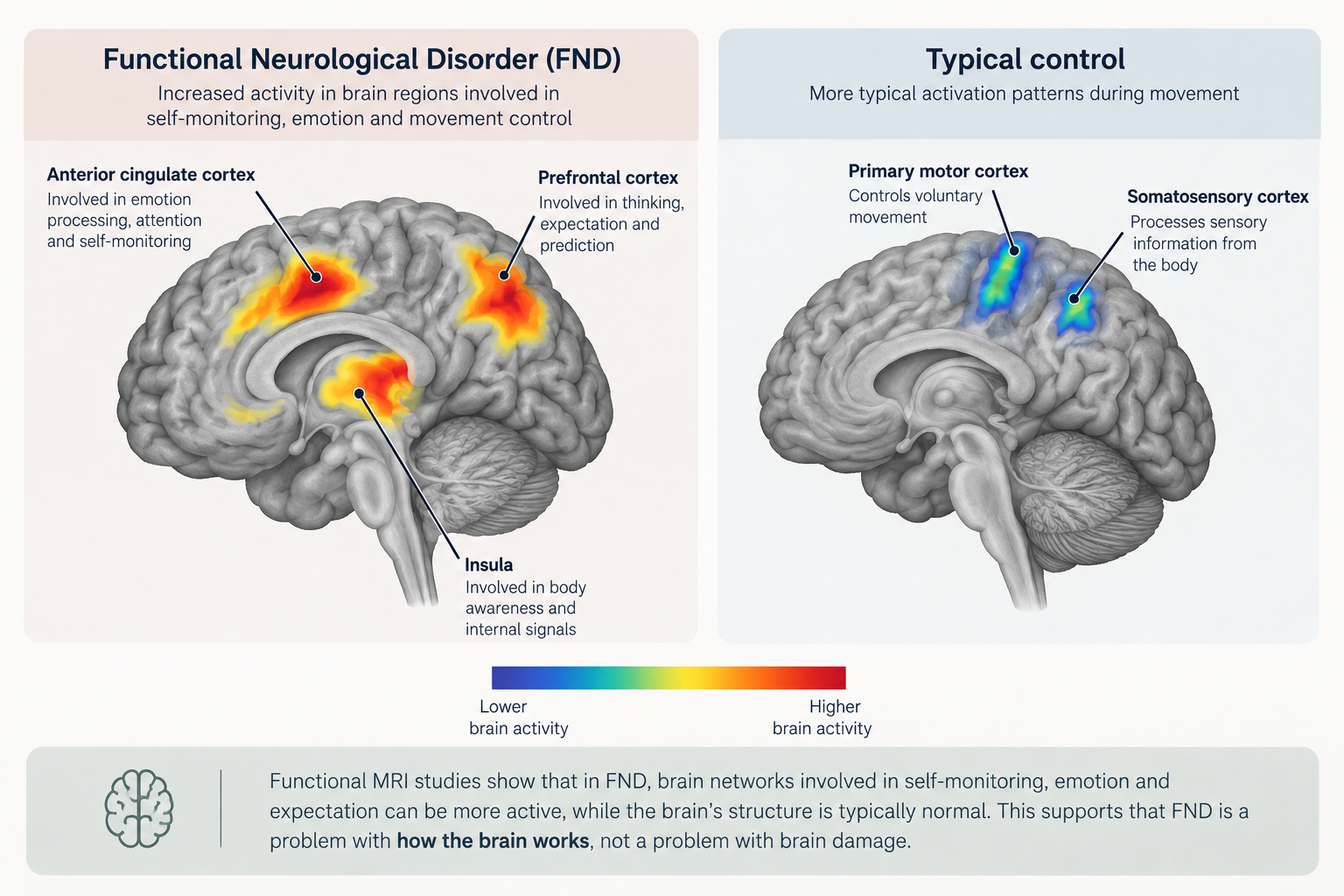
A functional MRI (fMRI) is different from a standard MRI scan. A standard MRI produces images of the brain’s structure. An fMRI looks at changes in brain activity and blood flow while different tasks are performed or while the brain is at rest. Researchers can use this to investigate how different areas and networks of the brain communicate and work together.
FND research using fMRI has identified differences across multiple brain networks involved in movement, attention, salience, emotion, interoception and sense of agency. These findings have helped demonstrate that FND is associated with measurable differences in brain function, even when a conventional structural MRI is normal.
However, fMRI is currently a research tool rather than a diagnostic test for FND in an individual person. There is no single fMRI pattern that can confirm or exclude FND.
FND can improve
FND is a complex condition and recovery is different for everyone. Some people experience substantial improvement or remission, while others continue to experience symptoms over the longer term.
Current evidence supports individualised, FND-informed rehabilitation, with physiotherapy playing an important role for people with functional motor symptoms. Multidisciplinary care may also include neurology, psychology, occupational therapy or speech and language therapy depending on the person's symptoms and needs.
Our aim is not simply to reduce symptoms. We want to help you understand what is happening, regain confidence in your movement and return to the activities that are important to you.
How The Rehab Team can help
At The Rehab Team, neurological rehabilitation is what we do every day. Our Neurological Physiotherapists work with people living with FND and other neurological conditions, giving us a strong understanding of how changes in the brain and nervous system can affect movement and function.
We provide in-home FND rehabilitation throughout Tauranga, Papamoa, Mount Maunganui and surrounding areas, with online appointments available throughout New Zealand. Online rehabilitation can work particularly well for FND, allowing us to support people who do not live locally.
Contact The Rehab Team today to arrange an FND physiotherapy assessment.
Help us develop our FND resources
We are working in the background to develop a digital FND resource (or two) designed to provide practical, accessible information and strategies for people living with FND.
If you have been diagnosed with FND, we would value your input as we develop this resource.
Complete our short, confidential feedback form to help shape the resource.